Handmade models highlight our history of space exploration


Inspired by Space Exploration, artist Tom Sachs has created his very own Space Program. Modules in the artist’s programs won’t go to infinity and beyond, or even into orbit, but these handmade models are an interesting take on the space program. The artist has created various models of historic importance in the space program, you can see beauties like Apollo lunar module, a mission control unit, space suits, NASA Hasselblad camera, and other objects in the artist’s Space Program project. The well detailed life-size models are imposing and awe-inspiring.

Via: PetaPixel
NASA cites space debris as an excuse of building a big-ass laser


The problem of space debris is serious, and it poses a serious threats to satellites and future space programs. Ergo, NASA has decided to build a big-ass laser to get rid of all this debris. It won’t zap the waste out, the laser will just slow them down enough so they lose their trajectory and fall under the influence of gravity. The laser would be powered at 5kW and would probably do its job well. Although we think the space debris is just an excuse for building a laser gun and shooting into space.

Via: TechnologyReview, Gearfuse

Sun photographed at a full 360 degrees


Researchers have managed to create the first 360-degree image of the sun. Images were captured using NASA’s twin STEREO (Solar Terrestrial Relations Observatory) spacecrafts, which happen to be orbitting opposite sides of the sun. Researchers at UK’s Rutherford Appleton laboratory designed the cameras for the mission and worked with NASA in creating the image.

Via: BirminghamMail, Core77

NASA calls on airplanes of 2025


Late last year, NASA asked Lockheed Martin, Northrop Grumman, Boeing to send in designs for the airplanes of the future, the planes that would rule the skies in 2025. Conditions for the designs were fairly practical; NASA wanted the planes to be low on noise, low on fuel consumption, and with cleaner exhausts. The planes are supposed to be able to fly at 85% of the speed of sound, ferry about 50,000 pounds to 100,000 pounds of payload (human or cargo), and have a range of 7000 miles.

Via: NASA, Gizmodo

NASA discovers remarkable arsenic-born organisms

NASA has announced the discovery of remarkable organisms, while many people were expecting this to be a discovery of extraterrestrial life, it is in fact, very much on Earth. To put the findings briefly, researchers have discovered a micro-organism in Mono Lake, California. This micro-organism can make use of arsenic to thrive and reproduce, completely replacing phosphorous/phosphates.

This is important because phosphorous is generally considered a building block of life, integral to our DNA and RNA. Arsenic on the other hand, is considered to be poisonous. The astrobiological finding means that life can exist with very different components than our current assumptions.

Via: Engadget

A solar eclipse, as seen by NASA’s Solar Dynamics Observatory

NASA’s Solar Dynamics Observatory (SDO) stays in a geosynchronous orbit around the earth, but keeps its “eyes” fixed on the sun and the solar variations. These images were taken when the SDO was looking at the sun in a high ultraviolet wavelength, and show the moon passing between the observatory and the sun, a solar eclipes for the SDO.

Via: Popsci

This is what our Solar System looks like to aliens

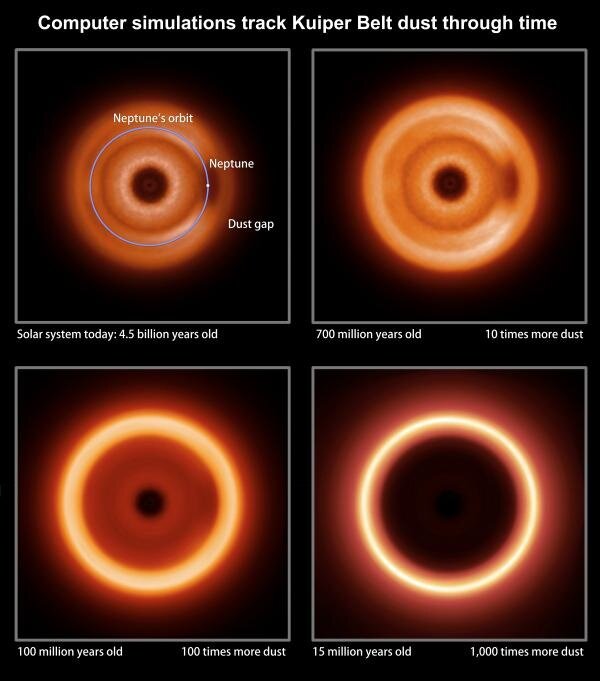
Researchers have run a lot of simulation using a supercomputer, to finally create images that show what are solar system would likely look like to alien astronomers looking our way. Additionally, the model also gives us a glimpse of what the solar system might have looked like as it evolved. While most of the planets are likely to be difficult to detect, Neptune may be easier to find for alien astronomers. The gravitational force of Neptune causes a gap in the dust originating in the Kuiper Belt. The model was created by using NASA’s discover supercomputer to keep a tab on some 75000 dust particles in the cold of the Kuiper belt.

Via: Science Daily

ISS crew spots green aurora over the Indian Ocean


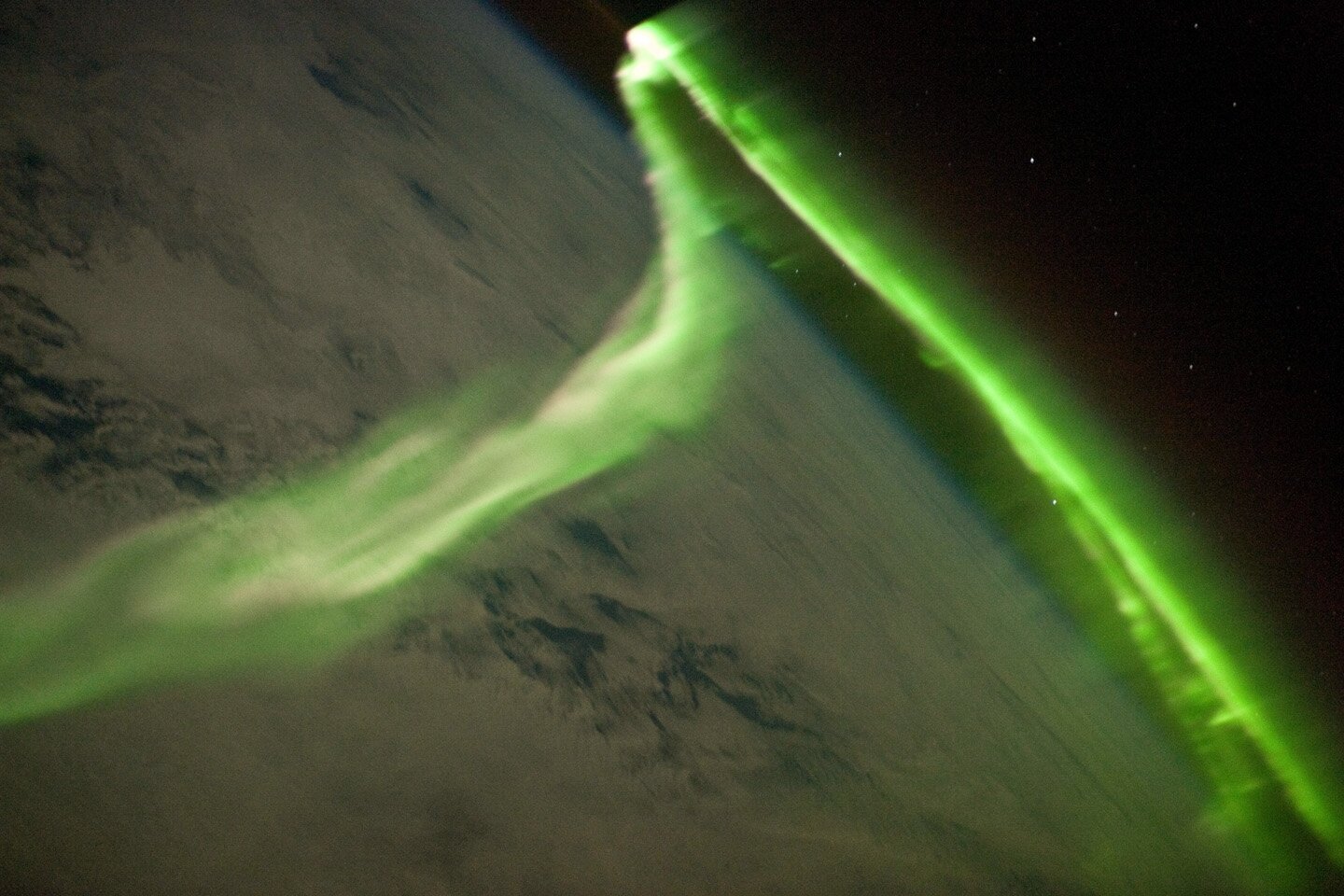
Astronauts aboard the International Space Station witnessed this unique and beautiful aurora australis over the southern Indian Ocean last month. Auroras occur when energetic ions from the sun collide with oxygen and nitrogen in the upper atmosphere, exciting these particles to an energy state where they emit light. The aurora borealis occurs near the north pole, while the aurora australis occurs near the south pole. This aurora is unique because it was relatively far from the southern pole. The green aurora probably occurred due to the large energy ejection from the sun on May 24.

Via: NASA, PopSci

Scientists debate the possibility of alien life on Saturn’s moon Titan

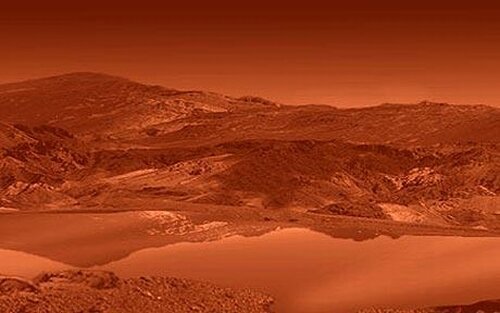
To be very specific, these are all theories right now, but many scientists are already wondering if methane based lifeforms actually do/could exist on the surface of Saturn’s moon Titan. While such speculation has gone on for long, researchers now believe that there is a good indication that primitive life forms may be inhabiting Titan.

WISE Satellite sees the heart and the soul of the universe

NASA’s WISE Satellite (Wide-field Infrared Survey Explorer) is on the job to map out the sky in infrared radiation. It is of course sending back images as it does its work, and one of them is of the Heart and Soul Nebulae. Both of these look like hearts, the one on the right being similar to the anatomical description, while the left is more like a “Valentine day heart.” Official names of the nebulae are IC 1848 and IC 1805.

Via: Scientific American